
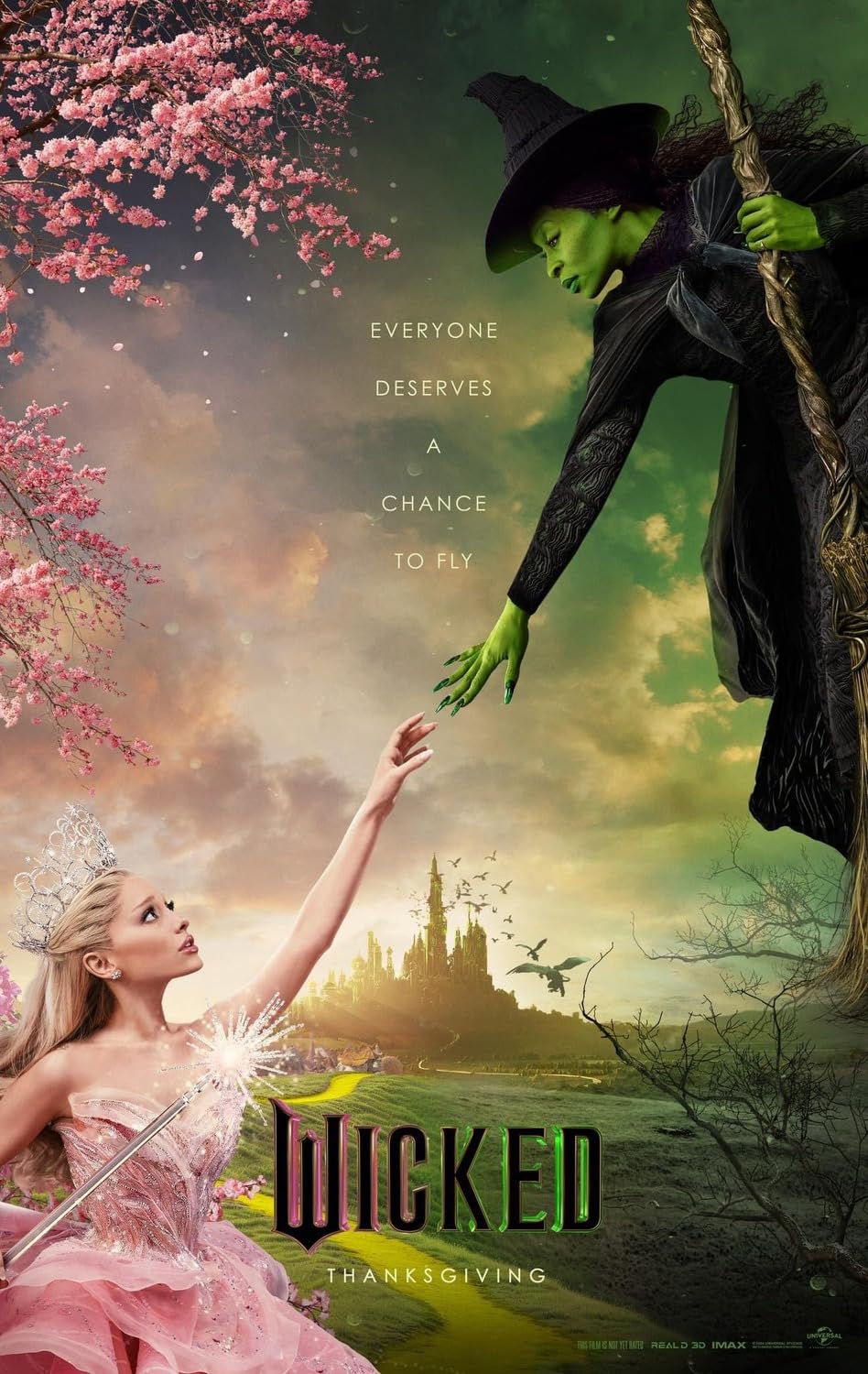

Wicked: For Good completes the faithful adaptation of a Broadway masterpiece.
The Broadway musical Wicked first hit movie theaters in November 2024, giving rise to both wild celebration of its artistry and sudden disappointment over its coverage: it was only Act One! But the year-long wait for the second act is finally over, and the result is a visually stunning movie that brings all the musical and philosophical sophistication of the stage show to the silver screen. It’s hard to think of a more entertaining way to spend two hours meditating on good and evil (and especially on the limitations of our good intentions).
If you receive this news with pleasant surprise, and find yourself breathing a sigh of relief, I get it. Co-stars Cynthia Erivo and Ariana Grande appeared many times in video clips on social media in the past year with suggestions that the movie would lean much harder on themes of racial and sexual identity; with the Wicked Witch of the West having been green from birth, it would be easy enough to reduce the whole work to a contemplation of grievance politics. Many longtime fans worried that Hollywood would diminish the musical masterpiece by sharpening its polemical point; that the movie(s) might be insufferably woke, as if they were handling not a once-in-a-generation masterpiece but some run-of-the-mill Pride Parade. The good news is that, whatever the co-stars said in interviews and whatever their reasons for saying it, the producers managed to keep the movie precisely over the rainbow, in that glorious place where the art is allowed to work on our imaginations without ham-fisted sermonizing.
For those who did not see the musical or the first installment of the movie (which I reviewed here), let’s bring you up to speed. Wicked (the musical version, adapted from a 1995 novel that doesn’t begin to measure up to its spinoff) presents a history of Oz before Dorothy (and her little dog too) arrived there. The surprise to those raised on the 1939 movie The Wizard of Oz is that the Wicked Witch of the West (named Elphaba at birth) and Glinda the Good Witch were friends, indeed college roommates. They had very different backgrounds—Glinda the popular child of privilege and Elphaba the outcast, unloved even by her own father—and in Act One we see each character grow as their friendship deepens. But their shared interest in a handsome but brainless classmate, Prince Fiyero, portends conflict ahead. As all three of them become aware that “something bad is happening in Oz,” Glinda characteristically wants to accommodate herself to the order established by the Wizard, whereas Elphaba sees deception at the root of that order and wants to unmask the Wizard as a fraud.
No one familiar with the 1939 movie will be shocked by the revelation that the Wizard is a fraud, but the movie never really dilated on the fact that the “Great and Powerful Oz” is also, apparently, the ultimate political authority in that land. By contrast, deception by political authority is at the heart of Wicked. The Wizard is evidently quite clever as a mechanic, and he seems to take a mechanistic approach to people as well. Thus, he uses his mechanical gift to mask the absence of any real ability as a sorcerer, mostly by inventing machines to fool the people of Oz. In this project, he is joined by Madame Morrible, whose original imposture is that she pretends to be qualified to teach sorcery, but restricts her lessons to only “gifted” students because she has only modest powers of her own. By the end of Act One (or the first Wicked movie), Elphaba realizes that the Wizard and Madame Morrible are pretenders imposing themselves on the people and animals of Oz. Armed with the knowledge that she and she alone possesses the power to defy gravity and cast other spells, Elphaba resolves to undermine the Wizard’s authority by exposing the lie upon which it is based.
This gives the second installment of the movie a somewhat darker character than Act One. Wicked: For Good opens with Madame Morrible’s voice warning Ozians about the Wicked Witch, in words and tones that would be equally at home in a movie adaptation of 1984. And here, as in most good dystopian works, we know that righteousness is not with the law but with the outlaw. Elphaba is called “wicked” by the authorities because she wants to tell the truth, and we the audience know this. Meanwhile, the Wizard is called “Wonderful” by the people because he and his propagandist lie to the people at every opportunity—and we know this as well. Why are the villains lying to preserve their power? Neither the musical nor the movie gives us a specific answer to that question, and thank goodness. The offense of public authority in this work is fundamentally against the truth. Many viewers today will interpret it differently than they would have twenty years ago, and that is entirely as it should be; that’s one of the things that makes great art timeless.
But if Wicked portrays public authority as characteristically corrupt, it is certainly no love letter to populism. On the contrary, the fallibility of public opinion is one of the major themes of the work. Virtually every song and every scene in which the public appears is informed by the knowledge that the Wizard and Madame Morrible are lying and getting away with it. I can’t be entirely sure without the scripts in front of me, but I think it is true in both the musical and the movies that the chorus is wrong about absolutely everything in the entire show. Primarily they are wrong about who is promoting their good and who is threatening it. They see goodness and wickedness in the wrong places not because they don’t know the difference between good and evil but because they’ve been misinformed and manipulated by the authorities in whom they’ve misplaced their trust. The Wizard’s cynical philosophy about goodness and wickedness is that “it’s all in which label / is able to persist.” Fortunately, that’s the view of the show’s villain, not its heroine.
If the first two great themes of Wicked concern public authority and public opinion, the other two great themes emphasize the limits of our ability to judge private motives. With our own motives and our own actions, we face the frequently ineliminable gap between intention and execution. As Burns said long ago, “The best-laid schemes o’ mice an’ men / Gang aft agley, / An’ lea’e us nought but grief an’ pain, / For promis’d joy!” Even when we mean well, the consequences may fall well short of our intentions. And conversely, even acts undertaken from vicious motives may bring about consequences that make our actions appear kind to the outside observer. The movie’s plot offers numerous examples: Glinda’s selfishness and even her casual cruelty in youth often benefit others and fill them with gratitude, while Elphaba’s best intentions often misfire and create deep resentment. Wicked also suggests that the corrupting influence of power—whether political or magical—makes it particularly likely that we will fail to “make good” on our good intentions when we are attempting to change the course of other people’s lives.
And what about other people’s motives? They are notoriously (and frustratingly) opaque to us. We typically judge others by observing the effects of their actions and surmising their intentions, but we often forget to “mind the gap” between the two. That is, we assume that others must have intended exactly what result they brought about when in fact, with others’ actions as with our own, the result is rarely fully foreseen and the intention is rarely perfectly executed. (C. S. Lewis’s devils make brilliant use of this phenomenon in The Screwtape Letters as well.) In Wicked, we get to watch some of the characters learn this for themselves, looking self-critically at the way they have judged others.
I have already, in my review of Act One, praised Stephen Schwartz’s score as the unrivaled star of this show. I hope I take nothing away from Cynthia Erivo or Ariana Grande or any of the women who have preceded them in the starring roles when I say that this show would be as well worth watching at most colleges and community theaters as it was on Broadway or in this adaptation; the score is that good. That said, Erivo and Grande can really sing! Schwartz wrote two new songs for the movie, “There’s No Place Like Home” for Elphaba and “The Girl in the Bubble” for Glinda. They didn’t get in the way, but I didn’t find them crucial to the work. The rewriting of the Wizard’s signature musical number and apologia, “Wonderful,” was more unfortunate; it seemed to me as if a finely crafted work of art had been puréed in a food processor. But I assume this was done in large part to accommodate the fact that the movie’s Wizard (Jeff Goldblum), like his accomplice Madame Morrible (Michelle Yeoh), can’t really sing. In a cast otherwise entirely composed of insanely talented vocalists, that had to be intentional, didn’t it? Almost as if the real villains, the real wickedness, needed to be discernable after all?
The movie also includes some new dramatic elements, some that definitely expand on the stage production and others that I at least didn’t remember from the stage. Among them are some scenes and lines that raised for me the question of what counts as magic in Oz? Throughout the movie, we come to know Elphaba as the witch with “real” magic, because she can fly. By contrast, Glinda needs the Wizard to craft her a mechanical vehicle that only simulates flight by bubble. But in the end, as Elphaba herself realizes in duet, Elphaba is limited in ways that Glinda is not. If the Wizard weaves spells with machines, and Madame Morrible weaves spells with press releases, and Elphaba weaves spells with ancient incantations, what is Glinda’s characteristic magic? That sounds like a question of vocation, one that we all must wrestle with.
Most of the questions raised by Wicked are like that: things we should all spend more time thinking about. How fortunate, then, that we have this wonderful work to help us. When I took my kids to see this musical more than fifteen years ago, I told them the bad news that this is the kind of show that only comes along once in a generation. In the years that have passed since then, I’m still waiting for its equal.